c
Here is a review of what the workgroups have done:
Groups made a "first effort" at making a fast robot. They recorded data and described the design of the drive train.
Groups then gradually edited programs to get the dragsters to "start on brighter," and to "record and display time", while "stopping on dark."
These designs were then rebuilt to try to make the 'bot go faster. Groups used real science to test the new designs. Data was recorded from time trials again to compare to the first set of data. Then analysis was done to determine if more speed was attainable.
I am very pleased with all of the groups results!! I am looking forward to next week to hear you explain what you accomplished.
Time Trials
Three-way Drag Race
More Drag Racing Dragbots
Wednesday, March 29, 2006


Wednesday, March 22, 2006
Queens Spring Challenges Revealed
Click here to see the Challenges.
The Region 4 Spring Pentathalon Challenge is upon us! Pentathalon means competing in five events. Teams will do their best to master each event to showcase and develop their engineering and programming skills.
The teacher in me really loves the mystery challenge because no one knows what it is until the day of the event. It causes teams' heart rates to increase and the energy levels to go off the charts.
I am looking forward to seeing what my students will come up with--I know they will surprise and impress with their creativity, engineering skills and programming finesse.
Thursday, March 02, 2006
Excellent Progress

Task: Build a robot that goes faster than everyone else's. Distance: ten feet.
Activity: Use Robolab technology to devise a method to measure the velocity of your RobotDragster.
Next: Use the data from your measurements to determine if adjustments are making your robot faster.
I am very pleased with student reactions to this new activity. We discussed how measuring velocity can be done internally or externally. I heard some clever ideas from groups about how they planned to accomplish this task.
I would like to see simple drawings of the code. I would like to see drawings of the external plans.
Some groups reported that using touch sensors to hit a whisker or gate at the end of the 10' could be a solution to stop a timer. Another group may use two sensors linked to a separate RCX to be a starting sensor, the other to be used as an finish line sensor. One group is using Robolab code to build an internal speedometer. All of these are excellent ideas.
Tuesday, February 21, 2006
Make it Faster, External or Internal Measurement
The next task is to make a robot faster than everybody else's.
Sounds simple. It is not.
I really love watching the results of our workgroups. I always learn from your efforts. What I have seen all of you make is exactly what any coach would expect. That is not a bad thing. I see it as the first thing. You all made dragsters that you say go fast.
What I would like you to consider is this: How do you know the robot "goes fast?" Prove it to yourselves then prove it to me.
The fastest team will not settle for the first design built. The fastest team will figure out a way to measure the speed of the robot. Then they will analyze all of the data at hand like the gears, the design and the speed trials.
Then a new robot will be built. It will be slower or faster. If you can tell how much faster or slower exactly and maybe why, then I know you learned something.
I want you to have an internal desire to use scientific methods to make the fastest robot. Here is an example of what I mean:
Let's look at a cars velocity. How is a car's velocity measured? The speedometer? How about the policeman's radar gun? A race fan's stopwatch? Everyone in class is measuring their robot's speed usinng their watches. Some have actually measured more than one trial! There is much error when using a watch.
Is there another method to measure a robots speed? Does Robolab offer any oppurtunities to count or measure speed, time or distance which are all factors of velocity? Can you build a "radar gun" and measure the robot's speed externally?
I can think of many different ways to measure the speed both externally and internally using Legos, the RCX, and Robolab. I want you to come up with an idea to measure the speed and make it happen. Then you should have a dependable way to create the data necessary to evaluate the effectiveness of your "fastbot."
Tuesday, January 31, 2006
And then?

This week and probably the rest of February, we will focus on two things:
A. Making sure everyone in the Robotics class can build a robot and program it to move and do a mission.
Some students are not contributing much effort to their work group. If you need something from me, ask. Other students, here and there, are telling me confidentially that a certain member is not helping too much and they feel like they have to do all of the work. This does not surprise me because I notice it myself. I have been doing "teacher things" to try and motivate everyone. I am very pleased that students feel comfortable approaching me about these types of matters. Not one person made personal remarks. Everything spoken about was about the work.
B. Science Fair Projects. We will devote as much time in class as possible to science Fair projects.
More on this later. For now, leave it at this. You have your regular Science class and the help from your Science teacher. You have Robotics three more times a week. With all of the extra computer time and materials at your fingertips in my room, maybe the name should be changed to Science Un-Fair.
Your project may be looked at in two ways. One part is the idea and the other part is how you present the idea. You know, "What are saying?" and "How are you saying it?" We have all sorts of presentation materials for you to use. And, I have many probes, such as temperature, pH, sound and pressure. I also have every possible electrical probe that is coupled with the RCX brick to record data. Don't forget I have cameras and video cameras if needed also.
You have time to do an in-depth inquiry and to prepare your presentation. I think it would be reasonable to expect the top ten places in the fair to be won by robotics students. Remember, you can not build a kit for your project.
Q. What is the hardest part about these types of activities for most students?
A. THE TOPIC! (Our next class discussion!)
Links to look into:
http://www.cdli.ca/sciencefairs/intermed.html
http://mathforum.org/teachers/mathproject.html
http://www.ipl.org/div/kidspace/projectguide/
http://www.chipublib.org/008subject/009scitech/scifideas.html
Monday, January 30, 2006
IS 93/Carnota Eagles Win Third in Design!
Today, I am letting the photographs do most of the talking. I am too exhausted from such a long weekend and the the stress from competing to write too much.
I will say I am proud to be the coach of such excellent students. Watching them compete with poise and dignity was quite an experience for me. I read their faces all day long and saw the many emotional ups and downs from the effects of competing and trying so hard.
We also had so many parents, friends and family present. "Thank you" to them for supporting us.


Friday, January 27, 2006
Working a Little Too Good!
The Skype exchange went off as planned today: Carnota and IS 93 communicated with a chat while both schools had video cameras running.
Here's the twist. Mr. Wright was not there to run it! I was in a meeting at 65 Court Street.
Mr. Daly, the other IS 93 Coach, and Xose Calvo, Principal and English Teacher in Carnota, set it up, got it running and successfully exchanged information. They even managed to pull off a virtual mission challenge. Students were actually the ones over here who set up the laptops, webcam and logged in to get it all going. Much credit goes to Eugene who acted as the "Operator." Skype likes to hang up on you! He was the troubleshooter.
Here's the second twist. Mr Wright, that's me, was sitting at table with executives of an international corporation and ten employees of the NYCDOE when my laptop starting talking in Spanish and Gallego!! I could not turn it down or off! Talk about the annoying cell-phone guy! I had to leave the room even though it was a huge disruption to the meeting. You know, everyone there wanted to see the video and to see who was having all that fun running robots and sharing all of that excitement talking to other students in another country.
I was very proud that my team could perform at this level without me.
Stay tuned for the FLL tournament this weekend.
Wednesday, January 25, 2006
Coaches pitch in, to tailor make the uniforms!
John Daly, Stock Market Teacher, and fellow Lego coach, helps to get the uniforms ready for the dress-rehearsal smack-down skype-out scheduled for this Friday.


Sunday, January 22, 2006
Carnota Progress
http://xosecalvo.blogspot.com/
I am very pleased with how things are going with our buddies in Carnota, Spain. Everytime I go to Xose's Corner there are new pictures showing his half of our team building robots and solving missions very quickly. On our side of the Atlantic, my half of the team some students are busy refining their techniques for the missions while others are finishing up the research project and deciding how to present their efforts.
Sunday, January 29, 2006, is our tournament. We will be ready to give our best efforts.
I can tell you that getting everything together, planning, planning, packing, traveling, and training in Carnota has made me and my students raise our own standards. Once we realized many more people out of our own classroom would be scrutinizing every little thing we were doing, we really wanted to do everything right. That made us prepare and execute with a little more pep in our step. My students worked very hard to get their robots as good as they could get them and the research questions were drawn up carefully as well. There is enthusiasm and sincerity in every ounce of my team's efforts.
Also, without Mr. John Daly holding down the US side of the team while I was gone, we would not be enjoying this project at all. He has endured the "Mr. Wright's Crash Course Tecnique" of learning. We never have enough time and he has taken on more and more with the team.
Real learning is taking place in a real world situation- I could not be happier with the results.
Wednesday, January 18, 2006
A Few Pictures From Spain
We spent many hours training our new teammates in Carnota last weekend.
I will be sharing pictures and some items of interest as I go.

This is me, Fred Wright, and Steve Shapinsky, Region 4, NYCBOE, Robotics Staff Developer, using Skype to have a video conference with our classmates and teachers back at IS 93 in NY from Spain.
 alt="" />
This is the lab in Carnota that we worked in. The view on the wall is from the room 301 where Mr. John Daly was webcasting the IS 93 students running missions on the challenge mat while our new teammates in Spain were watching and asking questions.
Saturday, January 14, 2006
Sabado in Carnota
Bienvenidos\Welcome
Yesterday was somethng else. I have not posted in a little while because we were very busy.
Summary:
Norm Scot, Steve Shapinsky and Fred Wright went to Spain to set up a relationship with a school there in a town called Carnota. We brought Lego Robotics kits and computers and many other technology devices and cables.
After meeting with the Principal and Technology teacher, we began training them in Lego Robotics. In order to share the experience, we used Skype.com to communicate with many students and teachers, principals and regional staff in New York City. Webcams and chats were used.
The technology did not work completely at first but eventually we got the video and audio to work along with the chat. That enabled both sides to see and hear what the other side was doing.
What was each side doing?
The New York side was demonstrating thier robots in action attemtping to score points on the field. The Carnota side was watching them. Other students on both sides were exchanging information about the Reasearch Project. IS 93 asking questions about ther effects of the Prestige oil spill. Carnota was blogging and skype-chatting back the answers to the questions.
Today, students in Carnota gave up a beautiful Saturday to learn Robotics with us. These girls are quick learners!


Steve Shapinsky teaching the Prinicpal and the Technology teacher how to do advanced Robolab so they can teach their half of opur team.
Thursday, January 12, 2006
Heathrow
Check back for more updates from Europe. Norm, Dan, Steve and Fred are waiting for a connecting flight to Spain. Mucho Latte!
We will contact Xose, the principal of the school in Carnota as soon as we unpack.
It's 11:00am here and 5:00am NY time.
See you later.
We will contact Xose, the principal of the school in Carnota as soon as we unpack.
It's 11:00am here and 5:00am NY time.
See you later.
Friday, December 30, 2005
Back in GEAR!

Happy New Year
January is crunch time! All of my students have very important ELA exams on the seventeenth. You also have our biggest event of the year- the First Lego League Ocean Oddyssey Challenge.
You will probably experience some pressure during January. We all feel pressure. We have to learn how to handle pressure and anxiety in life. Stress is another name for this stuff. Some people like pressure. It makes them perform better. They like deadlines. It helps to motivate them.
Some people do not like pressure. Stress makes them feel overwhelmed. That makes them feel like doing nothing. They work better without all of the anxiety that deadlines and test dates bring. Everyone is different. But as we get older and get more education and more resonsibility, we will get more stress, more pressure and experience more anxiety.
What can we do about it? Everyone will have to develop their own way of dealing with stress and deadlines. Personally, when I was younger I had really bad techniques for dealing with pressure. I would do nothing and procrastinate until the last minute. That created more stress and the work I produced was not as good as it could have been if I had done a little bit at a time.
Now I plan better.
I write out lists and make smaller chunks of things to do.
I also take breaks and exercise.
I try to get enough sleep and rest.
I try to eat healthy food.
And lastly:
BALANCE.
I have to balance what my priorities are.
The balance idea is hard. For my students, balance means you can't drop everything else except the ELA test prep. You still have other subjects and other things gong on in your lives that you can not neglect. Yet, there are some important things coming up that you have give a little more effort to. Try to come up with some way of balancing what you have to do.
Maybe you want to comment about everything you have to do in January. I would like to hear from all of my students.
Wednesday, December 21, 2005
Wednesday Wipeout Results
Last week was so much fun and we all learned so much from the added stress of the timer.
So, we have decided to have a weekly timed competition with a new name every week. Last week was the "Smack Down." This week was the Wednesday Wipeout."
Today's results:
So, we have decided to have a weekly timed competition with a new name every week. Last week was the "Smack Down." This week was the Wednesday Wipeout."
Today's results:
- Galileo run by Daniel 190 pts
- Coaches run by Mr. Daly 119 pts
- Cassini run by Gary 86 pts
The earlier part of the session was a riot. We all tuned up our Skype accounts to practice for communicating with our teammates in Spain. So we sat around a big table and Skyped each other. We had conference calls and conference chats going simultaneously- great fun! I posted a challenge "Send a picture file of a Lego gear to everyone in the chat." Skype functions allow file transferring, so first everyone had to search in Google images, then save to the My Pictures folder, and finally Send File. What a total panic! We all got it going but it was chaos because a window pops up for every file sent to each chat member and a window for every file received from every other chat member --so there was a whole bunch of windows going on! Uploading, downloading--crazy! Now we all know how to create conference calls, send files, chat and exchange information. I love this job.
Monday, December 19, 2005
Queens Lego Robotics Competition
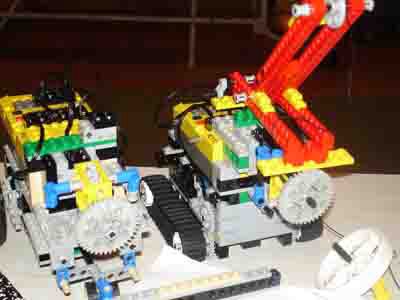
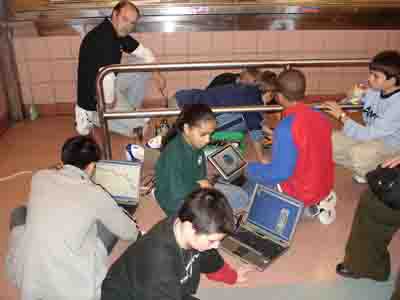
What a day!
 The First Lego League held the Borough of Queens Lego Robotics Competition Saturday, December 17th, 2005. Dozens of schools representing many neighborhoods of Queens showed up early carrying kits, bags of snacks, laptops, spare parts and robots.
Six dedicated members of the I.S.93 team showed with 3 parental units in tow! That was great because parents' are part of our team. My team had "the nerves." Gary and Robert took a bit too long to upgrade to fresh batteries and learned first hand about losing firmware in the RCX. That means they had to reload firmware, which should only take 4 minutes. The laptops display screen malfunctioned so another laptop had to be used. That took many minutes to reboot over and over. The nerves grew worse! Then the firmware gets re-loaded. Done. Next we used a flash drive to get the RCX's original code off the malfunctioning laptop. Since opening a .vi file from Robolab directly from clicking on the file is not an option, the files had to be copied deep into the program vault file, which was very time consuming. Next they read an error message that said we could not load files from a newer version of Robolab into a RCX with older firmware! That meant we loaded the wrong version of the firmware from an un-upgraded computer. Luckily we had a third laptop with compatible firmware and their files with their missions were tediously loaded into the brick again. Gary and Robert were very disappointed by all of that frustrating troubleshooting but the fact is they got it done and competed and did their best to accomplish missions. They even managed to score more points than some of the other schools.
Way to go! That kind of knowledge can not be taught- it's only to be gained by experienced.
Next, Gabby and Daniel did a great job with running their 'bot's missions. The spectators and Gabby's mom cheered when they brought the container to the base during the round. I was very proud of their performances because they showed concentration, a great attitude and scored lots and lots of points! They communicated their strategies over and over to ensure the predictable performance of the robot. The teamwork they showed was noticed by many observers.
The success of their robot was due to several factors which we focus on everyday during Lego Roboitcs at I.S. 93: Compact Robust Design, Flexibility in Design and Programming, Teamwork, Adaptablility, and On-The-Fly Problem Solving. All of these concepts were combined to produce a successful and FUN day of competing.
I was very proud of Daniel and Gabby. They showed enthusiasm and clever planning!
Lastly, Robert and Eugene scored the most points of any school's rounds at the tournament. That earned the I.S. 93 team first place in the competition. Their second round yielded the highest points which was the result of really excellent aiming and concise planning that was enhanced by constant strategizing, feedback and communication.
It is difficult to describe how I feel as a coach during these competitions. But the whole robotics experience makes me very proud. Region 4, NYCBOE supplied the training and resources. Steve Shapinsky and Norm Scott set up the tournament and was staffed by scores of adult volunteers and Long Island City HIgh School student volunteers. Our parents came and supported our students. My kids had every challenge and problem a poor robot could throw at them. They competed with poise and grace. We ate together, cheered together and had intense nervous stomachs together. I am blessed to be involved with such a program and I want to thank every single person there who competed, showed up, volunteered, cleaned up, referreed, mentored or who had anything else to do with the program.
A special thanks to Terry Bader for having the foresight to seek the funds and deliver a comprehensive robotics program region wide.
Wednesday, December 14, 2005
Cassini WorkGroup Mastering Design
Gary and Eric of the Cassini WorkGroup are demonstrating the slding action of their Robot.
Gary say," The hardest part of building this sliding arm was getting the pieces to touch the touch sensor the way we wanted."
When asked what was the importance of the touch sensor, Eric said, " When the bar pushes the touch sensor, we have it programmed for the motor to run back and forth. That's what makes the slider go back and forth."
They reportedly plan to knock flags over and connect the pipeline and protect the pump with this mechanism in the Ocean Odysey Challenge.
You can see them demonstrating the sliding bar here.
Smackdown Lego Challenge!!

Today at 4:oopm the long awaited Lego Smackdown happens. Mr. Wright/Mr. Daly take on the work groups to practice for competing at the FLL tournament.
Monday, December 12, 2005
Recurring Problems-New Solutions

Hi Everyone,
Several work groups are experiencing the same problems. Some of these problems include, but are not limited to:
-Difficulty traveling in a straight line.
-Turning the exact desired distance or angle.
-Traveling a very precise distance.
When you experience any or all of these three problems you will find that accomplishing ANY mission will seem impossible.
Your group will not likely score any points until you master the ability to get your robot to go across the game field and end up where the mission is set up for you to complete.
Some groups have overcome turning issues by using pivoting wheels- Good idea! Ask the Galileo group how they got their two-pivot design to straighten up. They used the advice of Dr. Antreasian, our mentor, to design in flexiblity. Galilieo uses a two-pivot robot to turn accurately to attempt several missions. They have a hard time getting it to go really straight for some other mission. They have solved this problem with a simple but brilliant solution. Find out what they did.
One last thing today: You may want to change your way of thinking about the following idea. "My robot has a front end and a back end." On Wednesday, you will see a demonstration of letting go of this concept when you see the Mr. Wright/Mr. Daly robot perform in the Wednesday Student Teacher Smackdown MiniChallenge!
Sunday, December 11, 2005
This Week:

Hello Everyone,
This is an important week for Lego Robotics at I.S.93. We have a practice tournament Saturday, December 17th from 9:00am to 2:00pm.
We need to look at this match as a dress rehearsal. This match will be like the FLL meet in January. There will be many rounds. You will be nervous. Things will happen. We have to depend on our brain power to plan, execute our game plan and then most importantly we will have to be able to adapt. We have the smarts to re-build and re-program right on the spot as conditions require. That is our strength as a team and will be the most stressful thing to accomplish.
They do not give awards for the team that enjoys themselves the most but I want to have fun doing this. I plan on having fun! I am very proud of our progress as a team. I hope you are planning to have fun- I do not want it to be an accident.
Last thing. All parents are invited. Ideally for me, there would be at least one parent for every student present. So ask them to come.
Monday, November 28, 2005
Galileo Group

The Galileo group chose their name after doing research on the NASA site--Great choice!
They also produced a great bulletin board describing the NASA Galileo mission. I learned so much about the project. I was very suprised the group went so in-depth to find the group name. Well done.
Picture Credit: http://www.pparc.ac.uk/Ap/Press/galileohi.jpg
Subscribe to:
Posts (Atom)


